
The Inaugural Lectures

LATEST LECTURE
Titled:
The Vigilant Watchman and The Serpent's Wisdom: Artificial Intelligence, Ethical Hacking, and The Future of Proactive Cyber Defence.
Delivered By:

Prof. Aderonke Justina Ikuomola
Dean, School of Computing
Email:
A Professor of Computer Science and Information Security in the Department of Cyber Security, School of Computing, Olusegun Agagu University of Science and Technology (OAUSTECH), Okitipupa, Ondo State, Nigeria. She obtained her B.Sc. degree in Computer Science from the University of Agriculture, Abeokuta, Ogun State, Nigeria with a Second Class Honours (Upper Division). Her M.Sc. and Ph.D. degrees in Computer Science was bagged at the Federal University of Agriculture, Abeokuta, Ogun State, Nigeria with Information Security as her area of specialization. She had formerly taught at Michael Otedola College of Primary Education, (the former Lagos State College of Primary Education), Noforija – Epe, Lagos, Nigeria (2003 – 2005), and later Federal College of Education (Technical), Akoka – Yaba, Lagos, Nigeria (2005 – 2008) while her university teaching career started at Federal University of Agriculture Abeokuta, Ogun State, Nigeria. (2008 – 2012).
Date:
Wednesday, 20th May, 2026.
OTHER LECTURES
School of Science:
School of Agriculture, Food and Natural Resources:
School of Management Science:
School of Computing:
5th Inaugural Lecture
Lecture Info.
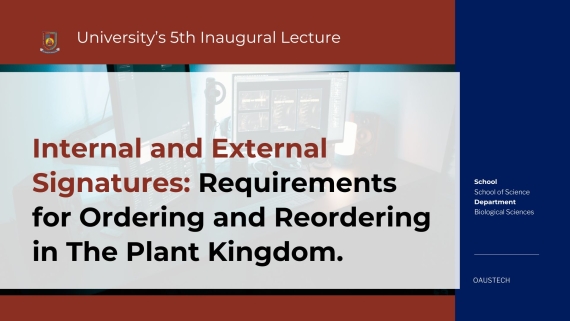
Title: Internal and External Signatures: Requirements for Ordering and Reordering in The Plant Kingdom.
Date: Wednesday 30th October, 2024
Time: 1pm.
Delivered By: Professor David Olaniran Aworinde
Professor of Botany (Plant Anatomy/Taxonomy),
Department of Biological Sciences, School of Science,
OAUSTECH
Preamble
Mr. Vice-Chancellor Sir, “This is the day that the Lord has made; I will rejoice and be glad in it”.It is a great and uncommon privilege for me to stand before you all today to deliver the fifth Inaugural lecture of the Olusegun Agagu University of Science and Technology, Okitipupa and the third from the School of Science and the Department of Biological Sciences. Incidentally, the first two from the Department had been from Microbiology and Plant Genetics; this is the first from Plant Taxonomy and Anatomy. I owe a debt of gratitude to God who has kept me thus far, to make this a possibility. No man can receive anything except he is given from above. I consider myself as one who has merely and solely received the grace of God. Born with no hope, no ambition, no class, no inheritance, and nothing to be reckoned with, by worldly standards. God in His infinite kindness has given me virtuous things with which to confound the wise, the rich, and the endowed so that I may boldly declare that I am truly a product of God’s grace.
Mr. Vice-Chancellor Sir, permit me to say that inaugural lectures presented by Professors provide an opportunity of presenting their career so far, update colleagues on current and future research plans, and introduce field of expertise to wider audiences. For the University, on the other hand, the event is a chance to recognize their achievement, host a celebratory event to bring staff together, and engage with audiences with a broader interest in its research including funders and decision makers from government, academia and the industry. With these definitions and clarifications, I feel honoured to present this inaugural lecture titled “Internal and External
Signatures: Requirements for Ordering and Reordering in the Plant Kingdom”.
Document
Click download below to get the 5th inaugural lecture copy


 Thursday, 31 October 2024 14:04
 9.86 MB
 3,885
3,885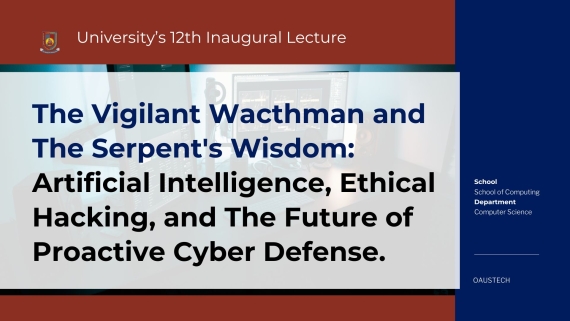
12th Inaugural Lecture
Lecture Info.
Title: The Vigilant Wacthman and The Serpent's Wisdom: Artificial Intelligence, Ethical Hacking, and The Future of Proactive Cyber Defense.
Date: Wednesday 20th May, 2026
Time: 1pm.
Delivered By:
Professor Aderonke Justina Ikuomola
Professor of Computer Science and Information Security,
Department of Cyber Security,
School of Computing,
OAUSTECH
Introduction: The Watchman and The Serpent
In an increasingly interconnected world, where digital technologies underpin nearly every facet of human existence, the challenge of securing cyberspace has become both critical and complex. From financial systems and healthcare infrastructures to national security and personal privacy, modern society depends profoundly on the integrity, confidentiality, and availability of information systems. Yet, as these systems evolve, so too do the threats that seek to undermine them (Anderson, 2020; Stallings, 2018). 6 To better understand the dynamics of cybersecurity in this contemporary era, it is useful to adopt a conceptual and philosophical lens - one that captures both the defensive and strategic dimensions of security.
This lecture introduces two enduring archetypes: the watchman and the serpent. The watchman, rooted in historical and cultural traditions, symbolizes vigilance, responsibility, and foresight. In ancient cities, watchmen were stationed on walls and towers, tasked with observing their environment, detecting threats, and warning inhabitants of impending danger. Their role was not merely reactive, but anticipatory - requiring constant alertness and the ability to interpret subtle signals (Dunn Cavelty, 2014). In the context of cybersecurity, the watchman represents systems and professionals dedicated to continuous monitoring and defense, including intrusion detection systems, security operations centers, and network surveillance mechanisms designed to identify and mitigate threats in real time. However, vigilance alone is insufficient in a threat landscape characterized by intelligence, adaptability, and deception. This is where the second archetype - the serpent - becomes relevant.
Traditionally associated with wisdom, subtlety, and strategic thinking, the serpent embodies the qualities required to navigate complex and adversarial environments. In cybersecurity, this metaphor aligns with the principles of ethical hacking and offensive security, where defenders adopt the mindset of attackers to uncover vulnerabilities before they can be exploited (Mitnick and Simon, 2011). Modern cyber adversaries are no longer opportunistic actors relying on simple techniques. They employ sophisticated tools, including artificial intelligence, automation, and social engineering, to orchestrate highly targeted and adaptive attacks (Goodfellow et al., 2018). These attackers think strategically, learn continuously, and exploit weaknesses with precision.
Consequently, effective cybersecurity requires more than passive defense; it demands intelligent, proactive, and adaptive strategies that mirror the ingenuity of the adversary. The convergence of these two archetypes - the vigilant watchman and the serpent’s wisdom - provides a powerful framework for understanding contemporary cybersecurity challenges. The watchman ensures continuous observation and rapid response, while the serpent introduces intelligence, creativity, and strategic foresight.
Together, they form the foundation of proactive cyber defense, where systems are designed not only to detect and respond to threats but also to anticipate and prevent them. Artificial intelligence (AI) has emerged as a transformative force within this paradigm. By enabling machines to learn from data, recognize patterns, and make decisions, AI enhances both vigilance and strategic capability. It empowers cybersecurity systems to move beyond static, rulebased approaches toward dynamic, self-learning models capable of adapting to evolving threats (Russell and Norvig, 2021). At the same time, AI introduces new risks, as adversaries leverage the same technologies to develop more sophisticated attacks, thereby intensifying the cybersecurity arms race. Ethical hacking further reinforces this dual paradigm by institutionalizing the serpent’s wisdom within defensive strategies.
Through penetration testing, vulnerability assessments, and red teaming exercises, ethical hackers simulate real-world attacks, exposing weaknesses that might otherwise remain undetected. This proactive approach affirms the principle that effective defense must be informed by intelligent and strategic offense (Scarfone and Mell, 2007). 7 This inaugural lecture argues that the future of cybersecurity lies in the integration of vigilance and intelligence - of watchfulness and wisdom. It presents a body of research spanning intelligent systems, intrusion detection, biometric security, cloud computing, and artificial intelligence, demonstrating how these domains converge to enable proactive cyber defense. It further explores the application of these concepts to emerging technologies, including the Internet of Things, smart systems, and national digital infrastructures.
Ultimately, the central thesis of this lecture is this: In a rapidly evolving digital landscape, cybersecurity must transcend passive defense and embrace a holistic paradigm that combines continuous vigilance with adaptive intelligence. The watchman must not only watch; he must understand. The serpent must not only be wise; it must act with purpose. Only through this synthesis can we build resilient, secure, and trustworthy digital systems for the future.
Contribution to Knowledge
The research contributions presented in this lecture are not incidental developments; they are deliberate and sustained responses to these identified challenges. Each strand of this work reflects 54 an attempt to overcome specific limitations - whether infrastructural, technological, human, or ethical - while advancing the broader vision of proactive, intelligent, and resilient cyber defense systems. What emerges, therefore, is not a collection of isolated studies, but a coherent intellectual response - one that transforms constraints into opportunities for innovation.
1. Context-Aware Intelligent Systems: Responding to Dynamic and Resource-Constrained Environments
2. AI-Driven Cybersecurity: Addressing Evolving Threats and AI Weaponization
3. Bridging Theory and Practice: Overcoming Infrastructure and Funding Constraints
4. Educational Technology and Smart Systems: Addressing Awareness and Human Vulnerabilities
5. Secure Architectures and Emerging Digital Ecosystems: Addressing Privacy, Policy, and Trust
6. Cross-Cutting Contributions: Toward a Holistic Cyber Defense Paradigm
During this period, the Computer Science programme operated as a unit under the Department of Mathematical Sciences, one of the four departments in the School of Sciences. The programme’s philosophy was deeply rooted in producing technologically competent graduates equipped to respond to societal needs in diverse computing fields.
Conclusion
In concluding this discourse, it becomes imperative to return to the guiding metaphor of this inaugural lecture -“The Vigilant Watchman and the Serpent’s Wisdom: Artificial Intelligence, Ethical Hacking, and the Future of Proactive Cyber Defense.” The vigilant watchman embodies the enduring need for constant awareness and protection in an increasingly complex digital landscape, while the serpent’s wisdom reflects strategic intelligence, adaptive foresight, and the ability to anticipate threats before they arise.
Together, they define the essence of modern cybersecurity as a deliberate fusion of vigilance and intelligence, where defense is proactive, dynamic, and continuously evolving. As digital ecosystems grow in scale and complexity, cybersecurity must move decisively beyond reactive approaches toward models grounded in prediction, adaptation, and automation. Artificial intelligence, ethical hacking, and intelligent systems have become indispensable in securing these environments. However, technology alone cannot guarantee safety; it must be reinforced by human awareness, ethical responsibility, and institutional preparedness.
The strength of future cyber defense will therefore lie in the balance between intelligent systems and responsible human oversight. Through the development of intelligent systems, AI-driven cybersecurity models, and secure digital architectures, this body of work has demonstrated that proactive cyber defense is both achievable and essential.” 60 This lecture ultimately affirms that securing the digital future is a shared responsibility. Governments, academia, industry, and individuals must work in concert to build resilient systems, develop sound policies, and sustain capacity development.
Cybersecurity is no longer merely a technical concern but a societal imperative that demands coordinated action and collective vigilance. Let us, therefore, rise to this moment with clarity and purpose. Let us be vigilant as watchmen - steadfast and prepared. Let us be wise as serpents - strategic and forward-looking. And above all, let us act with integrity, recognizing that every system we design and every safeguard we deploy reflects our commitment to a secure, trusted, and sustainable digital future.
Document
Click download below to get the 12th inaugural lecture copy
Subscribe to our Newsletter
About OAUSTECH
Olusegun Agagu University of Science and Technology (OAUSTECH), Okitipupa was established by the Ondo State government in 2008. It was initially named as Ondo State University of Science and Technology (OSUSTECH).
It is a technology-based institution, which aims at providing the needed manpower training for industrial and technological development of Ondo State and Nigeria as a whole.