
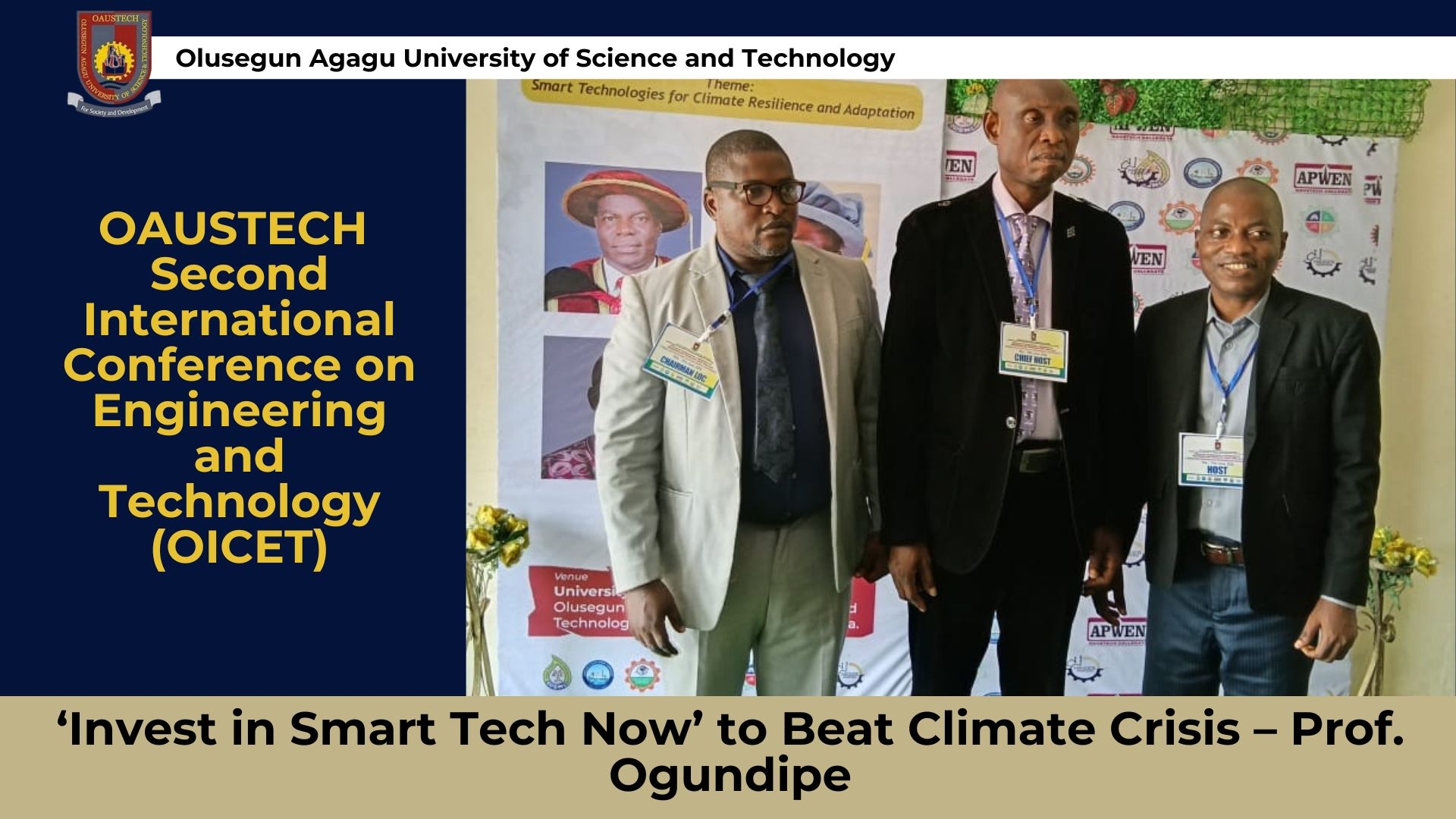
Prof. Ogundipe made the call in a keynote address at the 2nd OAUSTECH International Conference on Engineering and Technology (OICET), held at Olusegun Agagu University of Science and Technology, OAUSTECH, Okitipupa, from 15th to 17th June, 2026.
Speaking on “Smart Technologies for Climate Resilience and Adaptation”, the don said climate change is no longer a distant threat but a present reality disrupting weather, destroying infrastructure, farmlands, homes, and livelihoods worldwide.
Citing data from NEMA’s November 2025 flood dashboard, he said: “241 people died, 839 were injured, and 433,578 were affected across 123 LGAs in 27 states. We recorded 144,790 displaced persons, 52,509 houses damaged or destroyed, and 74,767 farmlands affected.”
He singled out the May 2025 flash floods in Tiffin Maza and Anguwan Hausawa, Mokwa LGA, Niger State, as the worst case.
“At least 500 people were confirmed killed, over 600 missing and presumed dead. The floods destroyed 4,000 houses, affected 45 schools, 44 health centres, and submerged 10,000 hectares of farmland,” Prof. Ogundipe stated.
To address the crisis, Prof. Ogundipe said Nigeria must quickly deploy smart technologies and build local capacity.
“We need weather apps, rainfall radar, storm and flood sensors, river-level monitors, and infrastructure designed for extreme conditions. We must also train citizens in basic digital skills and develop technologies suited to our communities,” he submitted.
In the lead paper titled “Computational Systems: Essential for Climate Change Adaptation and Resilience,” Prof. A. Yusuf of the University of South Africa urged countries to develop climate impact models and scenarios for states and regions.
“Beyond technical tools, we must re-orient our people to be kind to the environment,” Prof. Yusuf said.
Declaring the conference open, OAUSTECH Vice-Chancellor, Prof. Temi Ologunorisa, said universities have a critical role in research, collaboration, and knowledge sharing for sustainable climate action.
Represented by the Dean, School of Postgraduate Studies, Prof. Isaac Olaniyan, he added: “The climate-resilient future we want will not happen by chance. It requires the willingness to innovate, collaborate, and act decisively now.”
Acting Dean, School of Engineering and Engineering Technology, Dr. Francis Elehinafe, said OICET 2026 was “more than an academic event. It is a platform for rumination, innovation, and collaboration, a call for researchers to think differently, students to aspire, government to support, and young engineers to lead.”
He thanked the VC, management, sponsors, the local organizing committee, and all participants for making the conference a success.
The 3-day conference attracted scholars, professionals, researchers, policymakers, staff, and students from Nigeria and abroad.
Source:
Directorate of Information, Protocol and Public Relations (DIPPR),
OAUSTECH